
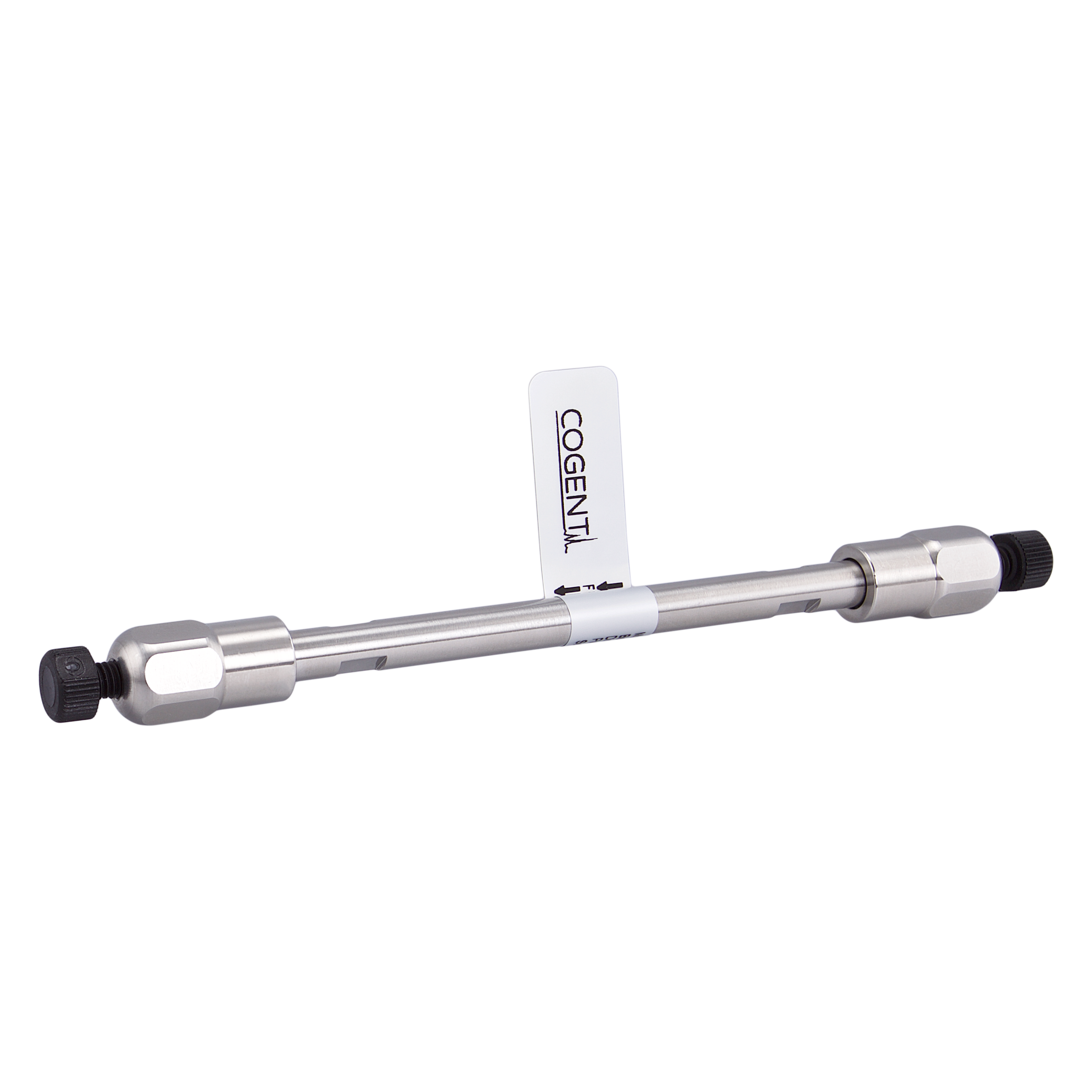
HPLC Column, RP C4 Butyl, Wide Pore, 5um, 2.1mm ID x 100mm Length, 300A. Cogent Brand. 1 EA.
Additional Information:
Cogent RP C4™ Wide Pore is a reversed-phase HPLC stationary phase designed for the separation of proteins, peptides, enzymes, and other large hydrophobic or neutral compounds. Manufactured using a four-carbon butyl ligand bonded to ultra-high purity silica and fully double end capped, this 300 Å wide pore stationary phase provides improved accessibility for large biomolecules while maintaining the reduced hydrophobic retention characteristic of C4 chemistry. The wide pore design makes it particularly well suited for bioanalytical applications where larger molecules require enhanced access to the bonded phase.
68504-10P-2-3M is an HPLC column packed with 5 µm RP C4™ Wide Pore particles featuring a 300 Å pore size in a 2.1 mm ID x 100 mm format. This narrow-bore configuration combines enhanced chromatographic resolution, reduced solvent consumption, and compatibility with LC-MS instrumentation. The 100 mm length provides greater resolving power than shorter column formats, while the 300 Å pore structure improves mass transfer and accessibility for larger biomolecules. Typical operating flow rates are approximately 0.2–0.3 mL/min. Because of the low flow rates required by 2.1 mm ID columns, standard HPLC systems must be capable of precise and reproducible low-flow operation.
This column is particularly useful for proteins, peptides, enzymes, and other large biomolecules analyzed by reversed-phase HPLC. The C4 bonded phase provides less hydrophobic retention than C8 and C18 phases, which can benefit large molecules that would otherwise be retained too strongly. The 2.1 mm ID format is frequently used for LC-MS methods requiring high sensitivity, low solvent consumption, and efficient analyte transfer to the mass spectrometer.
Key Benefits
RP C4™ Wide Pore stationary phase
USP L26 equivalent chemistry
Butyl bonded phase
Fully double end capped
Ultra-high purity silica support
300 Å wide pore design
Optimized for proteins and peptides
Lower hydrophobic retention than C8 phases
5 µm particle size
Excellent for LC-MS bioanalysis
Typical Applications
Protein analysis
Peptide analysis
Enzyme analysis
Bioanalytical methods
LC-MS methods
Biomolecule characterization
Pharmaceutical analysis
Biopharmaceutical analysis
Reversed-phase HPLC
Method development
Specifications
Product Type: HPLC Column
Stationary Phase: RP C4™ Wide Pore
USP Classification: L26
Chromatography Mode: Reversed Phase
Bonded Phase: Butyl (C4)
Endcapping: Fully Double End Capped
Particle Size: 5 µm
Pore Size: 300 Å
Column Dimensions: 2.1 mm ID x 100 mm
Length: 100 mm
Typical Flow Rate: 0.2–0.3 mL/min
Brand: Cogent
Important Notes
Designed for proteins, peptides, enzymes, and other large biomolecules
300 Å wide pores improve accessibility for larger analytes
Provides less retention than C8 and C18 stationary phases
Suitable for reversed-phase HPLC and LC-MS applications
The 2.1 mm ID format is ideal for reduced solvent consumption and mass spectrometry compatibility
Standard HPLC systems must be capable of reliable operation at approximately 0.2–0.3 mL/min
Detector flow cells should be optimized for low-volume, narrow-bore chromatography
The 100 mm length provides greater resolution than 50 mm columns while maintaining practical run times
5 µm particles provide low backpressure and robust operation
Frequently used for bioanalytical and biopharmaceutical applications